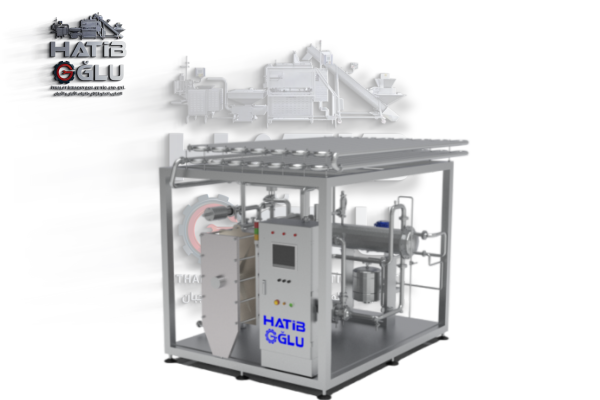
Pasteurization Unit
Machine constructed from high-quality stainless steel (AISI 304 / 316 / 316L)
Configurable from 3 to 8 stages
Two milk pumps (horsepower-rated)
Product flow control system
Adjustable final product temperature (4°C to 92°C)
Maximum operating temperature: 120°C
PLC touch-screen control system (fully automatic / Siemens)
Bypass system equipped with a temperature-controlled bypass valve
150-liter balance tank
Float-based balance tank level control system
Valves / Diaphragm control valves
Pasteurization unit stages:
_Main milk inlet
_Steam/Heating inlet
_Separator inlet
_Homogenizer inlet
_Pasteurization inlet
_Cooling inlet
_Holding section inlet (Stage 1: 30 seconds; Stage 2: 300 seconds)
Temperature gauge
Two Italian-made water pumps (Lowara)
Heating plates and exchangers (Swedish-made / Alfa Laval)
Danish-made heat exchanger (APV)
Product inlet/outlet sizes: DN40 / DN50 / DN76
The pasteurizer is a crucial piece of equipment in dairy processing plants. Its primary function is the thermal treatment of milk at specific temperatures and durations to eliminate pathogenic microorganisms and reduce microbial load, while preserving the milk's nutritional and sensory properties as much as possible.
🔹 How does the pasteurizer work? In modern dairy plants, the pasteurizer is typically a plate pasteurizer unit consisting of several stages:
1. Milk Reception
Raw milk enters the pasteurization line.
It first passes through a filter to remove impurities.
Depending on the production line design, it may also pass through a separator and a clarifier.
2. Pre-heating: The milk is gradually heated using a plate heat exchanger, often utilizing the hot milk exiting the pasteurization stage to recover heat and save energy.
3. Heating to Pasteurization Temperature: The milk reaches the required temperature based on the product type and the pasteurization system used.
4. The pasteurizer raises the raw milk temperature to the specified process level under controlled conditions and manages the holding time and subsequent cooling in accordance with the production line requirements. The system can be integrated into facilities producing dairy products, cheeses, yogurt, ayran, pasteurized milk, and juices.
. Holding Tube: After reaching the pasteurization temperature, the milk enters a holding tube designed to maintain the milk at the required temperature for a specific duration.
This stage is crucial because heat alone is insufficient; both the temperature and the time requirements must be met.
5. Diversion Valve: If the milk fails to reach the required temperature, the system automatically diverts it back to the heating stage instead of allowing it to proceed to the pasteurized product line.
This is one of the pasteurizer's most important safety mechanisms.
6. Cooling: After pasteurization is complete, the milk is rapidly cooled using the heat exchanger, typically reaching approximately 4°C when the goal is to store chilled pasteurized milk.
7. Discharge to Tank: The pasteurized milk moves to a pasteurized milk tank for temporary storage or is sent to subsequent processing stages. 8. It is important to distinguish between pasteurization equipment and UHT sterilization systems; they involve different processes, as UHT utilizes significantly higher temperatures and employs a different technology to produce long-life milk.
9. Pasteurization units vary depending on the specific product and client requirements.
Pasteurization units can be manufactured with production capacities ranging from 1.5 to 30 tons.
Technical specifications can be customized according to client requirements.