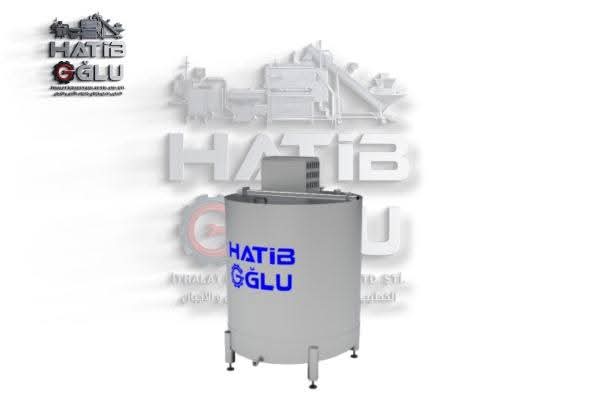
Cooking and Heating Tanks
All tank components are manufactured from high-quality stainless steel (AISI 304, 316, or 316L), based on client specifications and requirements.
Inner wall thickness: 3 mm.
Dimple jacket (Roll-bond) thickness: 2 mm.
Outer wall thickness: 3 mm.
Steam inlet and outlet.
Product inlet and outlet.
CIP (Clean-In-Place) inlet.
Double-walled construction with internal insulation.
Leg height of 35 cm to facilitate cleaning and sterilization.
Automatic electrical control panel.
Agitator with variable speed (up to 60 RPM) controlled by a VFD (inverter).
Agitator cover made of high-quality AISI 304 stainless steel.
Machine manufactured in compliance with European food industry standards.
Key features of milk heating tanks used in dairy and cheese processing plants include:
Uniform heating of milk from all sides to prevent the product from burning or sticking.
Double thermal jacket for heating milk using hot water or steam.
Precise temperature control via a thermal sensor and an automatic control system.
Option to equip the tank with an internal mixer to ensure even heat distribution.
Product-contact parts manufactured from food-grade stainless steel (AISI 304 or AISI 316).
High-quality thermal insulation to minimize heat loss and energy consumption.
Versatility in application: suitable for heating milk, preparing yogurt, and producing cheese and various dairy products, depending on the design.
CIP system for internal cleaning, facilitating the washing and sterilization process. Tanks can be manufactured in various capacities—such as 500, 1,000, 2,000, or 5,000 liters and larger—to suit production requirements.
A circulation pump can be added to ensure uniform temperature distribution during heating.
The design is hygienic and easy to clean, with product inlet and outlet ports configurable to match the production line.
It can be designed to operate using steam, hot water, or an electric heating system, depending on the facility's needs.
Key advantage: Combines uniform heating, precise temperature control, mixing, and thermal insulation to ensure stable milk processing and consistent product quality.