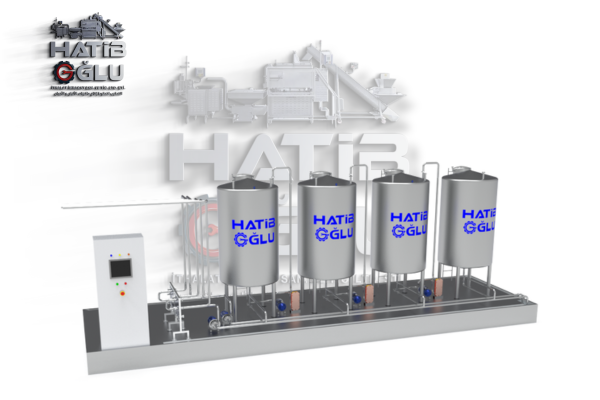
Clean-In-Place (CIP) Unit
Unit constructed from high-quality stainless steel (AISI 316/316L)
3 or 4 tanks (customizable upon request)
2 circulation pumps (dedicated to caustic and acid solutions)
Caustic tank
Acid tank
Hot water tank
Sterile water tank
Control panel with PLC screen for fully automatic control
Washing supply pump
Heat exchanger
PT100 temperature sensors
Product inlet/outlet connections (DN40/DN50, depending on fittings and accessories)
500 mm diameter vertical manhole
Complete unit mounted on a high-quality stainless steel (316L) platform
Internal capacity determined by production output requirements
Importance of the Automatic Self-Cleaning Unit
A scientific study on effective temperatures and the chemical agents/solutions used in Clean-In-Place (CIP) and Clean-Out-of-Place (COP) systems within food and beverage plants, in accordance with the latest global best practices.
=======================================
Clean-In-Place (CIP) and Clean-Out-of-Place (COP) systems are fundamental pillars for ensuring food safety and product quality in food and beverage manufacturing facilities. Its role is not limited to merely removing product residues; it extends to inhibiting biofilm formation, reducing microbial loads, and maintaining equipment efficiency and operational lifespan. This ensures the stability of production processes and compliance with regulatory requirements and international standards—such as Codex Alimentarius, FDA, EHEDG, 3-A Sanitary Standards, ISO 22000, and FSSC 22000.
Despite significant advancements in automated cleaning system design and the use of sophisticated software to control cleaning cycles, temperature remains a subject of considerable debate and misunderstanding within food processing plants. In many instances, temperature settings are adopted based on practical experience or inherited practices, rather than on the scientific principles that determine the optimal temperature for specific chemicals and types of contaminants.
A common misconception is that increasing the temperature always enhances cleaning efficiency. However, recent studies have demonstrated that exceeding optimal limits can yield counterproductive results, such as the fixation of proteins onto metal surfaces, increased mineral salt deposition, accelerated corrosion of system components, and higher energy and chemical consumption—all without achieving any actual improvement in cleaning efficiency.
Furthermore, there is often confusion regarding several concepts that, while similar, differ technically, such as:
* Cleaning solution temperature inside the CIP tank.
* Solution temperature upon entering the equipment.
* Solution temperature upon return (Return Temperature).
* Equipment surface temperature during cleaning.
* Temperature of initial, intermediate, and final rinse water.
* Thermal sterilization temperature. * Chemical Sanitization Temperature.
Each stage of the cleaning cycle has a distinct objective and specific operational requirements; consequently, a single temperature cannot be applied across all stages or for all chemical agents.
This issue has gained importance amidst the global shift toward improving energy and water efficiency and reducing carbon footprints. Modern Clean-in-Place (CIP) programs are designed to achieve maximum cleaning efficiency with minimal resource consumption. This necessitates the precise selection of temperatures, moving away from the simplistic notion that "higher heat always yields better cleaning."
The effectiveness of any cleaning program relies on four key elements—known in scientific literature as "Sinner’s Circle":
* Thermal energy (Temperature).
* Chemical energy (Chemical Action).
* Mechanical energy (Mechanical Action).
* Contact time (Time).
Balancing these elements is fundamental to successful cleaning operations; a reduction in one element can be compensated for by increasing another—within carefully calculated limits—without compromising equipment integrity or product quality.
This study aims to provide a comprehensive scientific and engineering review of temperatures used in CIP and Clean-out-of-Place (COP) systems within food and beverage facilities. It analyzes the impact of temperature on the efficiency of removing various contaminants, identifies optimal temperatures for specific cleaning chemicals and rinse water, and reviews common operational errors alongside global best practices endorsed by international bodies and leading manufacturers of cleaning equipment and systems. The study will draw upon the latest scientific references, specialized books, and technical guidelines issued by international organizations, serving as a practical resource for production, quality, and maintenance engineers, as well as plant managers, consultants, and professionals involved in the design, operation, or performance verification of cleaning systems in the food industry.