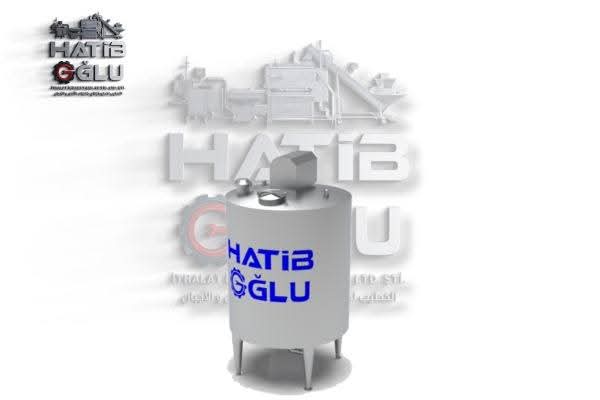
High-Speed Agitator Tank
All tank components are manufactured from high-quality stainless steel (AISI 304, 316, or 316L), depending on client specifications and manufacturing requirements.
Inner wall thickness: 3 mm or 4 mm.
Dimple jacket thickness: 2 mm.
Outer wall thickness: 3 mm.
Steam inlet and outlet.
Chiller (cooling) inlet and outlet.
Product inlet and outlet: DN 40 or DN 50.
CIP (Clean-in-Place) inlet.
Double-walled construction with internal insulation.
Leg height: 35 cm (to facilitate cleaning and sterilization).
Automatic electrical control panel.
Pressure relief valve.
Temperature gauge.
Agitator speed: 20–60 RPM (controlled via VFD/inverter).
High-speed agitation option (up to 3000 RPM) available via VFD control.
Automatic electrical control unit.
The Labneh fermentation tank is a key piece of equipment in Labneh production lines; it provides a suitable, controlled environment for fermenting milk and transforming it into a homogeneous product prior to the straining and concentration stages.
Ensures consistent fermentation conditions regarding temperature and duration.
Precise temperature control via a thermal jacket or a heating and cooling system.
Promotes uniform bacterial starter culture growth, contributing to consistent acidity and flavor.
Controls pH levels to achieve the desired texture and taste.
Ensures product homogeneity through an appropriate agitation system, utilized as needed during the manufacturing process.
Improves Labneh texture prior to the straining and concentration stages. Hygienic, easy-to-clean design; product-contact parts are typically made of food-grade AISI 304 stainless steel.
Compatible with CIP (Clean-in-Place) systems for cleaning and sterilization.
Option to integrate temperature and pH sensors, as well as a PLC control system for automation and fermentation process monitoring.
Available in various capacities to suit the plant's production output.
The fermentation tank ensures consistent Labneh quality—delivering uniform acidity, excellent texture, and stable flavor across batches—while minimizing manual intervention and errors during the fermentation process.
The tank can also be manufactured with a four-jacket system.
It is also available in either a closed or semi-open system configuration.